I am a scholar of visual culture and the environmental humanities. My work explores the politics and poetics of geographical representation, focusing particularly on historically marginal images of the earth as a whole. I also offer academic editing, book proposal, and grant writing support.
I received my MRes (with distinction) from the University of Warwick in 2012 and PhD (cum laude) from the University of Amsterdam in 2017. My project, Untimely World Pictures (2021–25), was funded by a prestigious Veni grant from the Dutch Research Council. I have taught art history at the University of Warwick, visual culture at Amsterdam University College, and globalization studies at the University of Amsterdam.
Born in Reading in the United Kingdom, I now live with my family in Hoorn in the Netherlands.
Contemporary media and culture are permeated by images of the earth as a measurable and malleable globe. This imagery crystallizes the dominant world picture underlying the Anthropocene, in which the planetary environment is offered up to human design and depletion. To explore alternative forms of planetary imagining, this book turns to images of the earth in historical art and visual culture. Approached as untimely—at once historical and alive in the present—these representations offer complex counters to dominant framings of the earth. I develop this argument through extended visual analyses of a selection of world pictures in dialogue with theories of geopower—the ways in which states, empires, and classes assert power over the planet. I focus particularly on three case studies, drawn from diverse periods and sociopolitical settings: Hieronymus Bosch’s late-medieval vision of the earth set before God’s gaze, with humans embedded in creation rather than beholding it from without; the personification of the earth in seventeenth-century Andean painting, in which it appears as an unmastered female sovereign who unsettles colonial extractivism; and the socialist artist Walter Crane’s nineteenth-century imagining of global revolution as heralding a renewed flourishing of planetary life, beyond economic utility. Attending to these past paradigms of depth and complexity in imagining the earth opens up new possibilities for interrogating geopower, connecting historical apprehensions of the earth with today’s fraught landscape of geopolitical struggle and ecological derangement. While far from being utopian alternatives that can simply be redeemed in the present, these untimely world pictures offer ways of recognizing planetary agency, imagining not more eyes on the earth but the eyes of the earth.
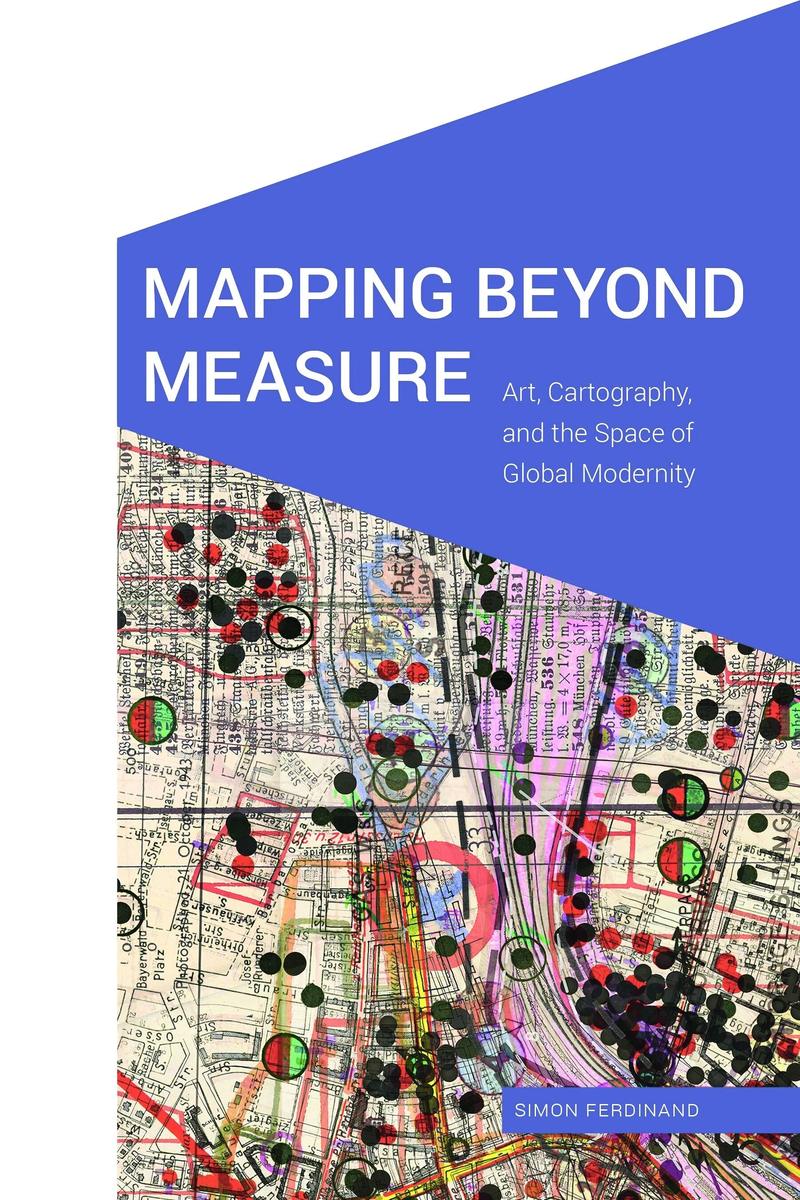
Art, Cartography, and the Space of Global Modernity
University of Nebraska Press, 2019
Over the last century a growing number of visual artists have been captivated by the entwinements of beauty and power, truth and artifice, and the fantasy and functionality they perceive in geographical mapmaking. This field of "map art" has moved into increasing prominence in recent years yet critical writing on the topic has been largely confined to general overviews of the field. In Mapping Beyond Measure Simon Ferdinand analyzes diverse map-based works of painting, collage, film, walking performance, and digital drawing made in Britain, Japan, the Netherlands, Ukraine, the United States, and the former Soviet Union, arguing that together they challenge the dominant modern view of the world as a measurable and malleable geometrical space. This challenge has strong political ramifications, for it is on the basis of modernity’s geometrical worldview that states have legislated over social space; that capital has coordinated global markets and exploited distant environments; and that powerful cartographic institutions have claimed exclusive authority in mapmaking. Mapping Beyond Measure breaks fresh ground in undertaking a series of close readings of significant map artworks in sustained dialogue with spatial theorists, including Peter Sloterdijk, Zygmunt Bauman, and Michel de Certeau. In so doing Ferdinand reveals how map art calls into question some of the central myths and narratives of rupture through which modern space has traditionally been imagined and establishes map art’s distinct value amid broader contemporary shifts toward digital mapping.
Mapping Beyond Measure is admirable for many reasons … Ferdinand’s text is an indispensable read for scholars who work at the intersection of cultural geography, critical cartography, and the visual arts as well as historians of art and visual culture … Ferdinand convincingly demonstrates how, by studying cartographic artworks, we can glean new insights about the role of map-making in the formation of modern institutions and processes of global modernization that shaped our past and continue to inform our present and future.
Kristan M. Hanson, H-Maps Reviews
Thought-provoking … Ferdinand impressively traverses a variety of interdisciplinary approaches from cartography, sociology, political and philosophical theory, as well as art analysis; one hopes he can expand this work into more publishing and even exhibitions. … Necessary reading for anyone concerned with the contemporary nexus of art and mapping.
Ruth Watson, Visual Studies 38.3/4
Ferdinand’s argument that art can help reveal both the potency and the spectrality of modern cartography’s claims to knowledge, at once tearing them down whilst also relying on them, is a powerful one, which offers an original, and compelling, contribution to ongoing geographical debates around mapping.
Dave McLaughlin, Social and Cultural Geography 23.2
Deep and wonderful … the author does superb work in analyzing art and cartography. … I recommend this book to a museum curator, art historian, artist, or person with a serious interest in art and/or cartography.
Lucia Lovison-Golob, Western Association of Map Libraries Bulletin 52.2
Mapping Beyond Measure is a fascinating exploration into the intersection of art, cartography, and philosophy. … An important work that will support the burgeoning field of critical cartography and of map art in general.
Zach Thorpe, Cartographic Perspectives 105
An innovative interpretation of contemporary artworks” and “perceptive exploration of how visual artists in our times have used the map form to relate to the world, to the globe, indeed to earth itself.
Sumathi Ramaswamy, author of Terrestrial Lessons: The Conquest of the World as Globe
An important book on a theoretical level ... By looking at recent technologies as a continuation of existing ontologies, Ferdinand goes beyond the hype around digital mapping.
Jess Bier, author of Mapping Israel, Mapping Palestine: How Occupied Landscapes Shape Scientific Knowledge
Amid accelerating planetary ecological derangement, escalating geopolitical competition, and emerging resistance to prevailing socioenvironmental relations, this volume attends to geopower: the forces, both human and nonhuman, that are shaping and emanating from the earth. Specifically, it examines how geopower intersects with aesthetics, taken expansively to include diverse practices, operational imaging, sensed materiality, and embodied perception. Examining diverse cases and contexts from around the planet, Aesthetics of Geopower shows how the earth’s forces are both delineating and playing out along contemporary political fault lines. Bringing together sixteen interdisciplinary specialists, the volume shows how the aesthetic, far from being secondary or supplemental to the forces shaping the earth, is centrally embedded in the dynamics of geopower. Whether in the construction of new extractive frontiers or the fostering of alternative, decolonial modes of imagining and inhabiting the planetary environment, the aesthetics of geopower are shaping the earth’s possible futures.
A globally expansive yet creatively hopeful analysis of local strategies of resistance – many through art making – challenging the techniques of geological extraction and transformation inevitably remaking the earth and its underground, airborne and watery resources. This book makes clear that we need to radically rethink these relations to the earth.
Can heterotopia help us make sense of globalisation? Against simplistic visions that the world is becoming one, Heterotopia and Globalisation in the Twenty-First Century shows how contemporary globalising processes are driven by heterotopian tension and complexities. A heterotopia, in Michel Foucault’s initial formulations, describes the spatial articulation of a discursive order, manifesting its own distinct logics and categories in ways that refract or disturb prevailing paradigms. While in the twenty-first century the concept of globalisation is frequently seen as a tumultuous undifferentiation of cultures and spaces, this volume breaks new ground by interrogating how heterotopia and globalisation in fact intersect in the cultural present. Bringing together contributors from disciplines including Geography, Literary Studies, Architecture, Sociology, Film Studies, and Philosophy, this volume sets out a new typology for heterotopian spaces in the globalising present. Together, the chapters argue that digital technologies, climate change, migration, and other globalising phenomena are giving rise to a heterotopian multiplicity of discursive spaces, which overlap and clash with one another in contemporary culture. This volume will be of interest to scholars across disciplines who are engaged with questions of spatial difference, globalising processes, and the ways they are imagined and represented.
Globalization has brought with it a sort of leveling or homogenizing force, but at the same time it had introduced hitherto unthinkable diversity and difference. This paradox lies at the heart of Heterotopia and Globalisation in the Twenty-First Century. The contributors examine different heterotopian spaces, but they also connect them to larger dynamics, such as tourism and migration, climate change, and digital technologies. The book will be of interest to scholars of these complex, but critical phenomena.
Robert T. Tally Jr., cultural geographies 28.1
These essays reveal an interconnected world increasingly dominated by digital technologies and neoliberal capitalist market forces. Heterotopia also has the potential to illuminate the realities of a planet in the throes of mass extinctions and climate change. … This interdisciplinary work will interest academics in philosophy, the social sciences, geography, film, literary studies, and architecture. Summing Up: Recommended.
J.H. Rubin, CHOICE: Current Reviews for Academic Libraries 58.6
This volume challenges dominant imaginations of globalization by highlighting alternative visions of the globe, world, earth, or planet that abound in cultural, social, and political practice. In the contemporary context of intensive globalization, ruthless geopolitics, and unabated environmental exploitation, these "other globes" offer paths for thinking anew the relations between people, polities, and the planet. Derived from disparate historical and cultural contexts, which include the Holy Roman Empire; late medieval Brabant; the (post)colonial Philippines; early twentieth-century Britain; contemporary Puerto Rico; occupied Palestine; postcolonial Africa and Chile; and present-day California, the past and peripheral globes analyzed in this volume reveal the variety of ways in which the global has been—and might be—imagined. As such, the fourteen contributions underline that there is no neutral, natural, or universal way of inhabiting the global.
The essays gathered here respond varyingly but diligently to two preoccupations laid out in the volume’s introduction: identifying and mobilizing older and peripheral imaginaries of the world/globe/planet to undermine the dominant imaginary that has organized globalization. … Rescuing ‘globes’ from their recent theoretical devaluations, Ferdinand’s contribution simultaneously undertakes a critique of ‘fetishized placehood’ and shows ‘place as the scene of our homelessness’.
Divya Dwivedi, Arcadia 55.1
In an era in which it has never felt more pressing that we explore our relations with the earth, interrogate our imaginations of the globe, and parse planetary thinking, Other Globes expertly assembles a series of empirically rich and theoretically astute contributions that do just this. This is indeed a collection for our times.
Harriet Hawkins, author of For Creative Geographies: Geography, Visual Arts and the Making of Worlds
Other Globes offers a compelling interdisciplinary and remarkably transnational argument for the notion that the view from nowhere is also one of many views from somewhere.
Benjamin Lazier, author of “Earthrise; or, The Globalization of the World Picture.”
This article examines how the earth has been personified as female in colonial, extractivist contexts, focusing on the Andean mining city of Potosí, the wresting of whose silver was pivotal for the emergence of global capitalism. Specifically, it attends to La Virgen del Cerro (The Virgin of the Mountain), a painting by an unknown artist working in the eighteenth-century Spanish Viceroyalty of Peru. It depicts the mineshaft-riven mountain above Potosí as the Virgin Mary, her hands and head superimposed onto its slopes. Whereas Carolyn Merchant argued that feminizing apprehensions of nature constrain resource extraction, La Virgen del Cerro sanctioned colonial silver mining. By transposing Mary’s “postpartum virginity” onto the Andean environment, the picture melds two usually distinct colonial tropes: nature as an alluring virgin and a nurturing mother. The earth becomes an inviting female body, gestating resources for imperial consumption. Reflecting on the globe depicted in the foreground, the article argues that this maternal earth is incubating global capitalism itself, whose emergence the painting envisions as nothing less than a holy birth.
Visual representations of the whole earth permeate modern cultures, shaping how societies imagine globalization and planetary ecological derangement. To explore the complex ways in which these images configure human attitudes toward environments, this essay attends to a series of hegemonic representations of the earth from diverse situations and stages of modernity in conjunction with ideas drawn from Martin Heidegger’s ontological philosophy. I proceed from the insight that for Heidegger modernity is not a singular condition, but entails two contrary determinations of being: “machination,” in which detached subjects reshape an objectified world, and “enordering,” in which fungible and flexible resources circulate endlessly around a closed global space. Taking up these divergent concepts, my argument accentuates basic differences in how the earth has been disclosed in representation over the course of modern history. Through close analyses of world maps from the early modern Netherlands; chalkboard globes from nineteenth-century schoolrooms; and the contemporary geospatial application Google Earth, I show how global visions both articulate and complicate Heidegger’s thinking of machination and enordering. Far from being the culmination of a singular modernity, images of the earth reveal and reinforce a discordant global condition, riven by clashing, equally total disclosures of the world.
Urban visual cultures are permeated by images of the global earth. From environmentalist posters presenting fragile whole earths, to logos that brand international corporations, these visual figures have dissolved into the scarcely scrutinized backdrop of everyday practice. This short article underlines the significance of this ‘banal globalism’ as the condition in which global discourses shape identities and frame experience in ways that elude conscious disputation. It indicates two complexities surrounding banal globalism. First I stress how the inconspicuousness and seeming triviality of banal global images exceed critical approaches based on the concentrated reading of visual objects. Then I indicate how such focused analysis can uncover rich and strange global visions that might otherwise be overlooked as part of the quotidian urban backdrop.
This article attends to the work of Dutch artist Gert Jan Kocken, one of the foremost arts practitioners to have drawn on geographical mapping for formal and thematic substance in recent years. Discussion focuses on his series the Depictions, in which found maps, made in pursuit of conflicting ideologies during the Second World War, are combined digitally into composite representations of cities such as Amsterdam, Berlin, and Rome. Layering together hundreds of different cartographies, the artworks provide a concentrated exploration of the connections between maps, states, and warfare. To grasp these connections, I read the Depictions in conjunction with Zygmunt Bauman’s conception of the modern state as a ‘gardener’ of society and space. In doing so, I highlight Kocken’s vivid demonstrations of not only the transformative potential released in state military mapping but also unevennesses and dialogic complexities with which even apparently totalising state gardening projects are fraught. My study of the Depictions builds an image of modernity as a contested garden; the article concludes by suggesting the commensurability of this vision with the social present.
In 1935 the Soviet artist Solomon Nikritin finished a painting entitled The Old and the New, depicting a bare geographical globe amid figures symbolizing tradition and progress in a nebulous wilderness. This article reads the picture as a reflection on how global cartography shapes modern modes of conceiving and inhabiting space. Drawing on Peter Sloterdijk’s argument that terrestrial globes manifest a posttheological spatiality and arch symbol of modernity, my exploration of The Old and the New stresses the conflicted implications of global mapping for modern culture. In Nikritin’s picture, globalism is seen to homeschool people from place, supplant traditional worldviews, and challenge modern subjects to consciously originate new spatial orders. The article closes by establishing the painting’s resonances with global discourses in Soviet and contemporary visual cultures, arguing that Nikritin’s picture focuses a continuing modern impulse to map meaning and order onto a disenchanted earth in which neither inhere.
Introduction · Heterotopia and Globalisation in the Twenty-First Century, Routledge
abstract
In this introductory chapter, the editors set out the volume’s two overarching arguments: first, that in embodying discursive disjunctures, heterotopias highlight the tensions and complexities inherent in the seemingly homogenising process of globalisation; and second, that twenty-first century globalisation has transformed heterotopian practice, in that digitisation, migration, and global environmental change are producing new discursive clashes at ever greater scales, new technologies and spaces, and new modes of cultural practice. The chapter also unpacks the volume’s specific take on the concept of heterotopia: we conceptually look forward – rather than backward towards Foucault or earlier stages of modernity – for further development of the concept of heterotopia; heterotopia are not unambiguously good or bad; and we foreground the relational and representational nature of heterotopia. The introduction concludes with an outline of chapters, emphasizing how each case study reconfigures heterotopia as a means of analysing the complexities in globalising processes unfolding today.
Contemporary media, politics, and culture are saturated by figures of the global and globalization. This Introduction emphasizes how many of these figures rest on a particular conception of the global. The editors term this “modern globalism,” within which the earth is grasped as a geometrical totality spanned by economic flows. Despite its prevalence today, modern globalism represents only one among many possible ways in which the global can be imagined; alternative global imaginations abound in the cultural past and at the peripheries of contemporary culture. These “other globes,” explored in the thirteen contributions that follow the Introduction, offer paths for thinking new relations between people, polities, and the planet. Laying the ground for the case studies, the Introduction unpacks alternative names for the global, exploring the cultural significance of earth, world, and planet; undertakes a genealogy of modern globalism, whose historical ascent marginalized other worldviews; and surveys critiques of modern globalism in Marxist, postcolonial, feminist, and ecocritical theory.
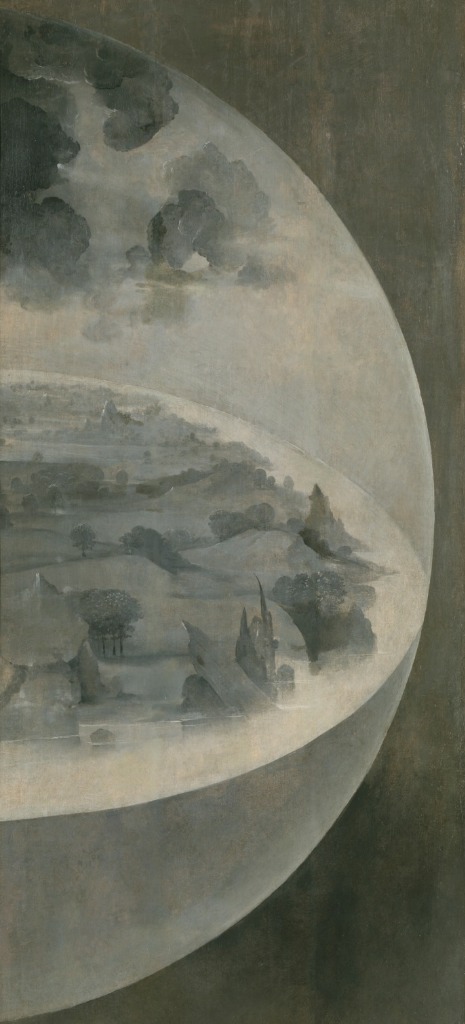
Modern cultures are permeated by representations of the earth as a measurable and malleable globe. To interrupt this dominant imagination of the global, this chapter reaches back to an early modern vision of the world depicted in Flemish painter Hieronymus Bosch’s so-called Garden of Earthly Delights. It analyses Garden’s exterior panels, which present the world as a horizontal landscape contained within a spherical globe, in conjunction with Tim Ingold’s account of how the global is perceived today. For Ingold, subjects are split between situated experiences of a flat surrounding horizon and prevailing visions of earth as a distanced globe. In combining horizontal and global perspectives, Garden encapsulates this account. However, whereas Ingold affirms situated existence against estranged global overviews, Bosch’s art blocks recourse to place-based dwelling. In his Christian worldview, all earthly existence—whether grasped through individual places or as the whole globe—is spiritually estranged from God.
2019
Prehistòries de l’effect de la Visió des de Dalt
Catalog essay · Apunts sobre la impossibilitat de la imatge del món, Institut D’Estudis Ilerdencs
2019
Worlds Apart: Prehistories of the Overview Effect / Χωριστοί Κόσμοι: Προϊστορίες της Πανοραμικής Εντύπωσης
Catalog essay · Non-Catalog, Thessaloniki Film Festival Publications
Chapter · Visualising the Street, Amsterdam University Press
abstract
To explore the shifting status of the street in contemporary mapping culture, this chapter attends to two map-based walking performances by US-born artist Jeremy Wood, who uses Global Positioning Systems to transform grounded mobility into a means of cartographic inscription. Whereas Michel de Certeau describes cartography as an elevated visuality, regimenting urban practice from above, my argument stresses how Wood’s mappings conflate lived mobility and synoptic cartography. Extending mapping to the street, his practice exemplifies digital mapping’s expansion beyond institutional domains. To close, however, I show how Wood’s art also exposes slippages and pretentions of existential security in digital mapping’s worldview of securely calculated locations, which are recast as ghostly projections in a universe without essential orientation.
2015
On the Untimeliness of Alison Hildreth’s Printmaking 1974–2014
Catalog essay · Alison Hildreth, Printmaking 1974–2014, Edition One Books
 Cover forthcoming